Can psilocybin help people stop smoking?
If you've ever tried to quit smoking and failed, probably more than once, you're far from alone.
Relapse rates after an attempt to quit smoking sit somewhere between 80 and 91% within a year. This is unsurprising given nicotine is widely considered one of the hardest addictions to quit due to its fast action and how deeply it weaves into both daily routines and social behaviours.
Nicotine patches, gum, sheer willpower: none of these quitting techniques work nearly as well as we'd like, and remarkably, there has been a hiatus in the development of new smoking cessation medications over the last two decades in the UK, bar the licensing of the prescription-only treatment of cytisine in 2024.
So when a trial comes along suggesting an intervention might deeply shift the odds of quitting, it's worth paying attention. Especially when that something is a single dose of psychedelic mushrooms.

The study, published in JAMA Network Open in March, involved 82 adults who wanted to quit smoking and had tried unsuccessfully before. Researchers at Johns Hopkins randomly assigned them to psilocybin or nicotine patches. Both groups received 13 weeks of cognitive behavioural therapy.
People who received a single supervised dose of psilocybin, alongside therapy, were around four times as likely to achieve sustained abstinence from smoking at six months as those given nicotine patches with the same therapy programme.
The findings raise a question that extends beyond tobacco: can a psychedelic experience help interrupt an established pattern of substance use?
What might change during treatment
“Pattern breaking” is one way to describe this possibility. It is not an established explanation for how psychedelics treat addiction. With psilocybin, researchers are investigating whether changes in perspective and psychological flexibility - the ability to respond differently to familiar thoughts or urges - help people change their behaviour.
Some clues come from interviews with 12 participants in an earlier smoking-cessation study in which participants described new insights into their identities and reasons for smoking. People described insights into their identities and reasons for smoking, alongside experiences of connection and renewed curiosity that lasted beyond the session. They also emphasised preparation and their relationship with the study team. Some said their psychedelic experiences had become more important to them than the discomfort of withdrawal.
These accounts suggest that, for some people, the experience changed the significance of smoking in their lives.
Matthew Johnson, who led the recent trial and joins the Psychedelic Society for an online talk on 29 September, has described participants becoming less constrained by habitual ways of thinking about themselves and respond to cravings with more choice. Someone who has spent years assuming they will always be a smoker might begin to find another future imaginable.The hypothesis is that a person can become better able to notice an urge without acting on it.
A promising direction for addiction treatment
The strength of the Johns Hopkins result is its comparison with an established treatment. For participants who had already tried unsuccessfully to quit, that represents a meaningful improvement and a strong reason to pursue the research.
Larger studies can now test how widely that benefit extends and whether it lasts beyond six months. Establishing who benefits, what support they need and how lasting the change can be is the next step towards making that possibility clinically useful.
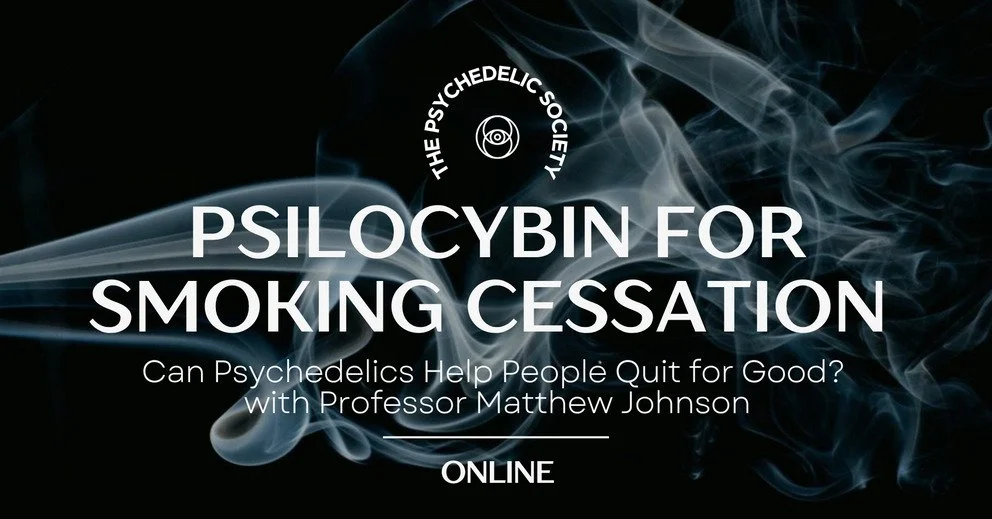
Discuss the findings with Matthew Johnson
Professor Matthew Johnson joins the Psychedelic Society online on Tuesday 29 September to discuss the smoking trial, participants’ experiences and the evidence behind proposed mechanisms of change, with time for questions.
Johnson has been studying psychedelics since 2004, and in 2021 became the first researcher in fifty years to receive a US federal grant to study a classic psychedelic as a treatment. He's now running a large follow-up study backed by a $4 million NIH grant, building directly on these results. He's also discussed this research with Lex Fridman, Andrew Huberman, 60 Minutes, the BBC and more, so this event presents a rare chance to hear it straight from him, live, and to ask your own questions.
In the talk, he'll walk through what participants actually describe during and after a psilocybin session (hint: it's often less about the trip itself and more about a lasting shift in how they relate to smoking), and the emerging neuroscience behind it, including the idea that psychedelics may briefly reopen "windows" in the brain that make old habits easier to unlearn. He'll also be honest about what we still don't know: how well this replicates, whether the effect holds up over the long term, and who this intervention may both likely and unlikely to help.
As smoking remains the leading preventable cause of death worldwide, if this early promise holds up under bigger trials, it could be one of the more significant developments in addiction treatment in a generation. Whether you're a researcher, a clinician, someone curious about psychedelics as medicine, or just someone who's tried and failed to quit before, this topic may be well worth your evening.
Notably, this is an educational talk, not a clinical or medical consultation and no therapeutic advice will be given at the event. If you can’t make it live, every ticket holder gets access to the recording within 24–48 hours.