Are we optimising ourselves into emptiness? Reflections on Bryan Johnson
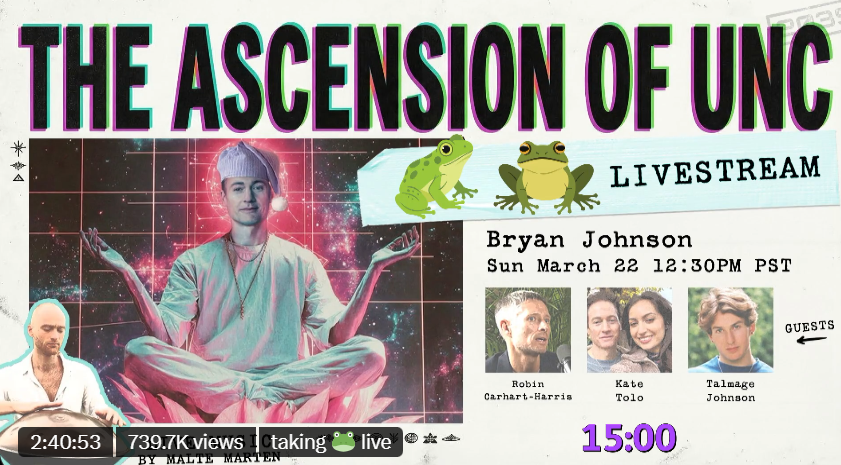
This week, Bryan Johnson, a man whose entire philosophy is called "Don't Die" took the substance most reliably described as simulating death. He livestreamed it. He called it his best longevity hack.
We have some thoughts.
Bryan Johnson is the purest expression of what modern civilisation has decided a human life is for.
The centimillionaire biohacker reportedly spends $2 million a year tracking hundreds of biomarkers, taking over 100 supplements, and subjecting himself to experimental therapies including plasma exchanges with his own son - all in pursuit of a single goal: to never die. His Netflix documentary is called Don't Die. His philosophy is called Immortalism. Johnson isn't just a biohacker. He's a prophet building a temple. And last week, he sat in a white clinical room off the coast of Vancouver and livestreamed himself taking 27mg of 5-MeO-DMT to prove it was the life-hack to top all life-hacks.
The religion of self-improvement
We have built a modern religion around the optimisation of the self: tracking it, extending it, perfecting it, refusing to let it go.
Sleep scores, HRV, blood panels, biological age - the self has become a project, a machine to be debugged. The Quantified Self movement, born in Silicon Valley in 2007, gave this impulse a motto: self-knowledge through numbers. Gary Wolf and Kevin Kelly, its founders, asked a simple question: we use numbers to optimise a car, an assembly line, an election - why not use numbers on ourselves?
We could be like "mini-corporations" tended to with constant self-development and investment. What could possibly go wrong?
Cognitive scientist John Vervaeke argues this impulse is a symptom of something deeply awry - a meaning crisis signalling disconnection from ourselves, from each other, from the world, and from a viable and foreseeable future.
89% of 16-29 year olds in the UK report that their life has no meaning. Into that void, we pour data. We are, Vervaeke says, suffering from a spiritual famine in the West - a culture that has replaced wisdom with information, and being with measurement.
But what if the self you're so furiously optimising is itself the illusion?
An optimised illusion
Every wisdom tradition points in the same direction. Buddhism's anatta - the doctrine of no-self - was the Buddha's most radical teaching: a direct challenge to the deeply held belief in an unchanging self. The Sufi concept of fana, the mystical Christian death of ego, the Daoist dissolution into the natural order - all converge on the same insight: the bounded, solid self is not the ground of existence. It is a useful fiction.
Psychedelics put a spanner in the works of the self-model. At the point of ego dissolution, the integrity of the self degrades, and we’re offered vivid experiential proof that the self conditioning experience is just a heuristic, not an unchangeable, persisting thing.
But crucially, what opens up in that space is not nothing - it is connection. Psychedelics (and all altered states of consciousness) offer a glimpse into a radically different mode of being - one characterised by profound interconnectedness, where the self is experienced as deeply embedded within the web of life on Earth.
The medicine doesn't upgrade the self. It returns us to our sense of belonging to the whole.
Bryan Johnson will die
Nobody embodies the collision of these two worldviews more completely - or more fascinatingly - than Bryan Johnson and his viral following. His manifesto, published this week on the Spring Equinox, is a striking document - part systems theory, part economic critique, part scripture. Some of it is genuinely compelling. He argues that modern capitalism is a "die economy" - one that rewards financial productivity while systematically degrading the biological systems that sustain life. Chronic stress, poor sleep, social fragmentation - civilisational self-harm, he calls it.
It's a diagnosis with real force. But the manifesto ends with a quote from Revelations - "There will be no more death’ followed by: "Don't Die. A prophecy fulfilled."
It's a remarkable move. A spiritual reading of that passage would laugh at it being used as evidence. Because every mystic tradition knows it’s not talking about biological survival or something that can be tracked or extended: it is the dissolution of the fear of death itself, the discovery that what we fundamentally are was never mortal in the way we imagined.
This molecule doesn’t care about your metrics
What 5-MeO-DMT delivered was also precisely the opposite of everything Johnson has spent millions constructing. He went in framing it as a longevity experiment - arguing that dissolving the Default Mode Network could return the brain to a more youthful state, that the experience might resemble the technological singularity.
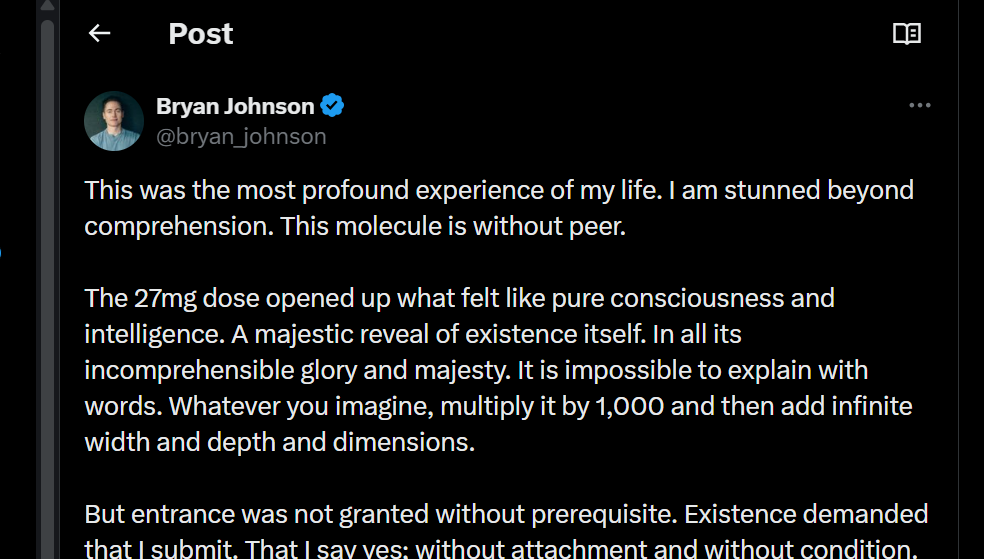
And yet what came back from the other side was not a data point. It was grief, awe, devotion. A warrior and caretaker of life. That is not the language of biohacking. It is the language of every mystic tradition Johnson's manifesto gently dismisses as ancient stories we told before science arrived to do the job properly.
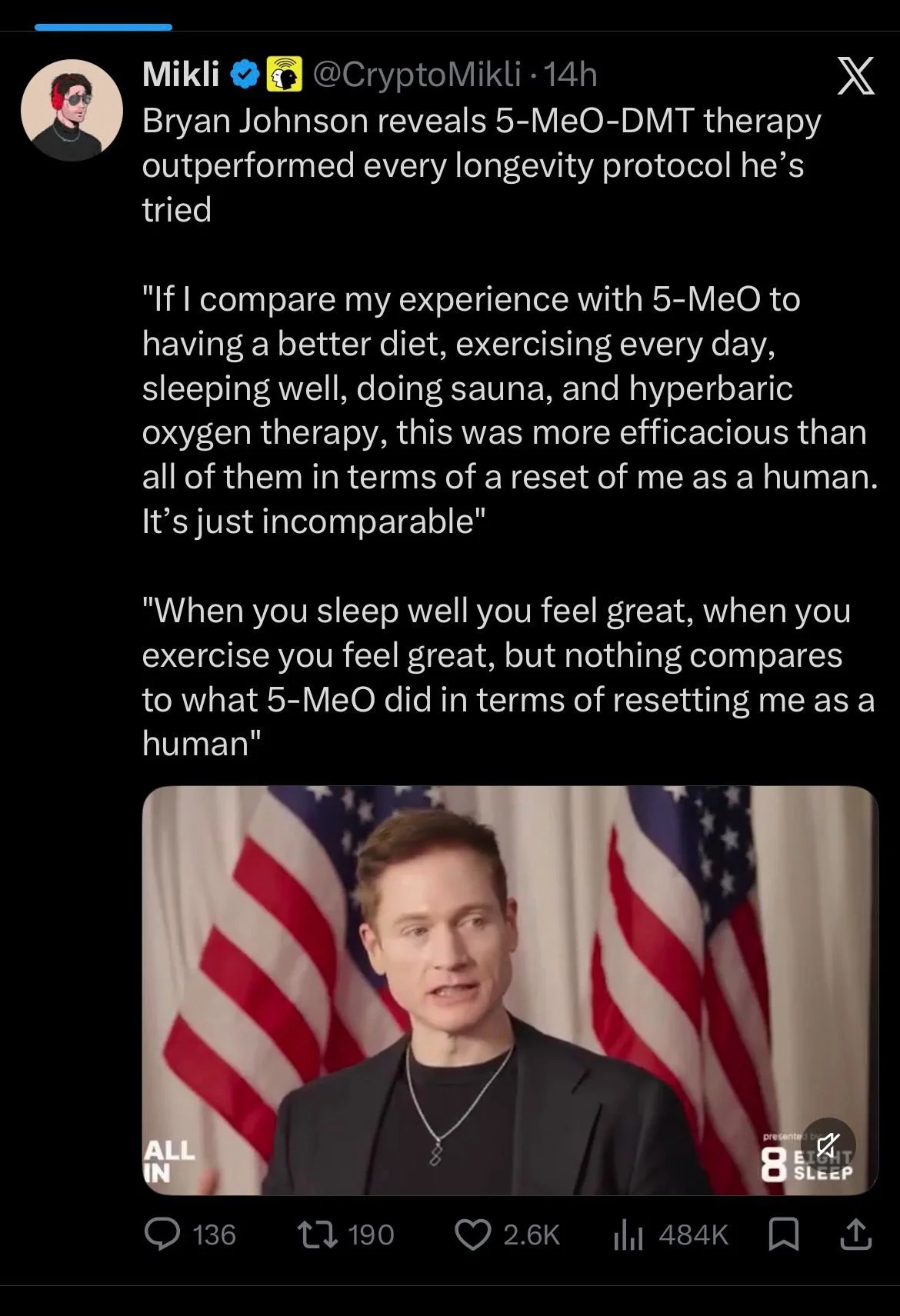
He travelled further into those traditions in thirty minutes than most people do in a lifetime. Then, within days, came the answer. Johnson revealed that 5-MeO-DMT had "outperformed every longevity protocol he'd ever tried" - more efficacious than diet, exercise, sleep, sauna, hyperbaric oxygen. "A reset of me as a human," he called it. Not a dissolution. Not a humbling. A reset. The infinite, benchmarked.
He livestreamed the whole thing, of course - because in an age where even healing is content, nothing is allowed to remain private, sacred, or unmonetised. We’re not sure how we feel about this. Something in it feels inherently off, dismissive, a violation of the sacred - and yet there is power in the witnessing.
These medicines have never belonged to the individual. In their traditional contexts - in ceremony, in community, on the land - they were always relational experiences, held within a web of relationships that gave them meaning and allowed their gifts to be integrated into a life and into a community. Is this another form?
But if we have somehow participated in this journey, the biggest question follows - what now?
What comes next?
What comes next after a profound experience is never answered in the room where it happens. It is answered in how we live afterwards - in whether we return to the same operating system or allow something genuinely new to take root. Integration is slow, unglamorous work. It does not trend. And it is almost always done better in community than alone.
So these are the questions we're sitting with this week - and that sit at the heart of everything we're building at the Psychedelic Society. We've been investing in community leads across cities in the UK, creating spaces where people can genuinely find each other. We're taking people into nature - on walks, in groups, in the open air - because the reconnection these medicines point toward needs to be embodied and lived, not just experienced once and filed away.
Why do we take these substances, and to what end?
What does it mean to approach these medicines as another upgrade, rather than an invitation to genuinely not know who we are?
What would it mean to let the experience change not just how we feel, but what we want - what we build, who we serve?
And what happens when the most powerful ego-dissolution tool known to science is taken by someone who has built an entire civilisational philosophy around the supremacy of the self?
The most powerful thing these medicines offer - if we let them - is not a reset. It’s a humbling. It’s a return. Not to a better version of yourself. But to the web of life you never stopped belonging to.